Crane Ropes


Crane Rope Suppliers
Rope Services Direct are suppliers of specialist crane ropes and cables, which are ideally suited to a broad range of both cranes. Cranes use wire ropes on their main hoists, auxiliary hoists, trolleys and booms; we can provide suitable rope for them all.
Crane ropes can be supplied with rotation resistant properties as well as other key elements such as compacted constructions and plastic impregnated ropes. Warrington cores are another excellent feature of some of our high performance crane ropes.
For more information on the products and services we supply, email RSD today or call 01384 78004 to discuss your current requirements.
Types Of Crane Rope for Different Crane Designs

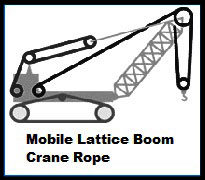
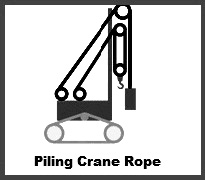
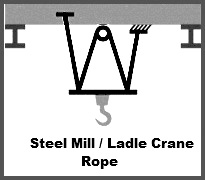
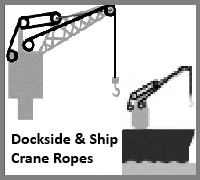
About Crane Ropes
There are many types of cranes which require the use ropes and cables, there are also many types of rope constructions with varying properties, which means there are many things to consider when purchasing new crane ropes.
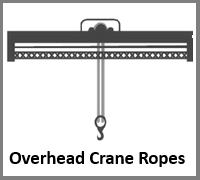
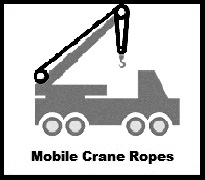
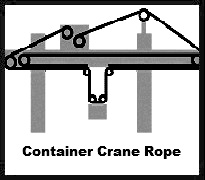
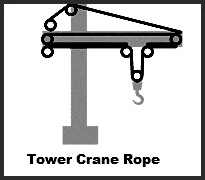
Overhead cranes, mobile cranes, all terrain cranes, crawler cranes, tower cranes, gantry cranes, off-shore pedestal cranes, dredger cranes, piling cranes, harbour cranes, and container cranes all use wire crane ropes, some cranes use more than one. You can find some helpful information on the safe use of cranes here.
Crane ropes can be used for main hoist rope, boom rope, trolley rope and auxiliary hoist rope. Derrick rope, closing rope and grab rope are other examples.
Matching the ideal rope for your type of crane and application is not so easy. This is because no single rope will fit all requirements. For example no one rope has the same fatigue resistant, crush resistant, abrasion resistant and rotation resistant properties. Nor have the same breaking strength, rope diameter and/or rope structure stability. So choosing the right rope may require a little research.
Good examples are: boom hoists should be crush resistant. Clam shell closing lines must be resistant to bend fatigue, whilst overhead crane hoist rope requires strength and rotation resistant stability. For a container crane hoist rope or trolley rope the rope will need to have a combination of resistance to bending and abrasion as well as fatigue resistance. Many crane ropes benefit from rotation resistant properties. Trolley rope needs low elongation properties and boom hoist rope needs high flexibility and breaking load strength.
It is usually recommended to choose a crane wire rope that is an exact or close match to the original rope supplied with the crane by the manufacturer, or else choose more superior crane ropes.
Considerations for Choosing Crane Rope
STRENGTH:
A crane ropes strength is generally referred to with minimum breaking load(MBL) and/or tensile strength - MPa (Mega Pascals).
MBL defines the minimum force at rope failure. (breaking strength)
MPa defines the internal stress point (fracture stress) at rope failure. (tensile strength of material)
It is possible to increase the MBL for most rope diameters in two ways:
By increasing the tensile strength of the actual wire used during the manufacturing process the MBL will increase. 1770N/mm², 1960N/mm² & 2160N/mm² are common wire tensile grades used in crane ropes. It is also feasible to raise the steel fill factor of the rope to increase its strength further. The fill factor measures cross sectional areas of the rope.
A more effective way of increasing the strength of a rope is to compact them. The individual strands may be compacted which reduces the number of voids throughout the rope. It also increases the surface contact area. This type of compacted wire rope has many other benefits which are discussed on our compacted wire rope page. Lower stress levels take place when conventional ropes are changed for compacted wire ropes. Frequently resulting in easier operation and longer working life. This is why the majority of our crane ropes are compacted.
DIAMETER;
The correct diameter is crucial to performance on a crane. A wire rope which is too big or too small for the drum and sheaves will increase wear and fatigue. This could cause premature rope failure. Additionally it is crucial that you make sure the diameter is consistent over the length of the rope. Inconsistency could cause wire breaks and shorten the ropes life. The use of compacted rope enables the same strength as a standard rope of the same construction but with a smaller diameter. It is always wise to select a rope with the same diameter as the original.
CRUSH RESISTANCE;
When choosing a crane rope, a wire core as opposed to a fibre core will improve its resistance to crushing. This is important when sheaves and drum winding is used.
Compacted rope, plastic impregnated rope and/or a Warrington core rope will also offer greater crush resistance as a result of its high fill factor, than that of conventional rope.
BEND FATIGUE RESISTANCE;
This is the capability of the rope to tolerate repetitive bending under constant or variable loads. This is possibly one of the most important properties of a crane rope due to its use with sheaves. As loads increase when a reeving system is used the fatigue rate will also increase.
A rope with more strands will possess greater fatigue resistance and more flexibility than a rope with less strands, compacted rope will add extra fatigue life. Plastic impregnated ropes are a great option for added flexibility and fatigue resistance.
ROTATION RESISTANCE;
Rotation resistance is usually a top priority for a crane ropes, especially main hoist rope. This is to prevent loads spinning uncontrollably.
Non-rotating wire rope is created with layers (typically 3) of strands twisted in opposite/alternate directions. Some will also have a Warrington core for high performance with added protection and strength.
RESISTANCE TO WEAR AND ABRASION;
The primary reason for abrasive wear on crane ropes is brought on by other apparatus like winding drums and sheaves. This is because the rope wears between adjoining laps when wound on or off the drum. Selecting compacted rope may minimise this kind of wear and tear.
Whilst selecting crane wire rope, keep in mind that the bigger the outer wires the better resistance to wear and abrasion. Therefore ropes with the lower the number i.e. 6x19 will be better than a higher number i.e. 6x36 when utilised where wear and abrasion are the key reason for rope deterioration as opposed to bend fatigue.
Again a compacted rope with its smoother surface will offer a wider bearing surface to conventional rope, this leads to improved resistance to wear and abrasion. PIR or plastic impregnated rope provide excellent abrasion resistance to internal wires.
CORROISON RESISTANCE;
If crane ropes are going to be utilised in a place where corrosive substances are used then it’s best to select a rope which has a galvanized finish. A ‘P.I.R.’ or plastic impregnated wire ropes are most suitable for severe craning operations, or plastic coated wire rope will also help to avoid corrosion.
LUBRICATION;
Lubricating your wire-rope needs to be done on a regular basis, using a high performance appropriate lubricant.
When lubricating your rope with a high performance lubricant has a major effect regarding the life of the rope, especially in relation to bend resistance. Lubricating the wire rope additionally minimizes abrasive wear and extends fatigue life
Other Lifting Equipment
Rope Services Direct can fit most fittings to your crane rope, having our own press facilities, we are are also able to supply a range of lifting gear and accessories to work well with cranes. From slings and shackles to chain blocks and trolleys.